

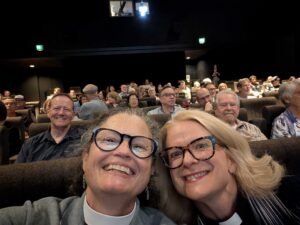
The Episcopal Church of the Resurrection hosted a nearly sold-out crowd at the Broadway Theatre for a viewing of “The Lake”. This event was organized by two ECOR members, Lisa Jensen and Lisa Groen, as a kickoff to The Episcopal Church’s Season of Creation Care.
I was asked to serve on the post-viewing panel following the film. Having never seen the film, but having extensive knowledge of the plight of the Great Salt Lake, I was curious about the experience I was entering into. Normally when I serve on a panel, I am well prepared in advance. In this instance, I, like much of the audience, I was experiencing the film for the first time.
When the opening scenes of devastation came onto the screen, I wondered if there was any way I would be able to add anything to the panel other than the salt of my own tears.
The filmmaker, Abby Ellis, was not out to sensationalize the decline of the Great Salt Lake. Quickly, the audience was immersed in the human aspect of the lake’s decline. We joined in bedtime with a lead scientist and his kids. We watched anguish wash across the face of the (now former) Commissioner of the GSL as more and more decline occurred along with the rising calculations of toxic dust. We saw his respect for the farmers he negotiated with, and the commitment to bring scientific proof to the legislators and governor.
The emotions of the audience cycled from despair to resolve over and over. The documentary itself left us with the information that despite the legislature committing insufficient funds to essential dust monitoring and restoration efforts, private philanthropy efforts raised hundreds of millions of dollars.
And that was it. The documentary ended leaving us all wondering whether salvation would come.
I looked at my watch as I headed back to the car.
8:40 pm.
How many people would possibly walk the nearly three blocks to the Episcopal Retreat and Conference Center? Twenty? If we were lucky.
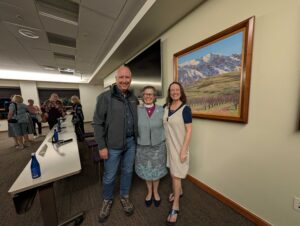
I entered the beautifully set up room with the other two panelists already at the front table. As I expected 20 – 30 people filed into the chairs. And then, to my amazement, the walkers began to arrive. The room was filled with people who stayed until nearly 10 pm asking insightful questions.
Many of whom were not Episcopalian and likely did not know that we were gathered in a church facility until the beautiful prayer for God’s Creation was prayed at the end of the evening.
Here is the moral of the evening: The Episcopal Church stands with the marginalized. We speak truth to power with the love of Jesus in our hearts. We believe in science. We value the farmer. We live our faith according to the Third Way.
Where there are two disparate view points, we look for the Third Way, the divine path through what is to what grace can illuminate.
What we don’t do is wait for someone else to solve the problem. We walk the Way of St. Francis. We speak for the voiceless.
The filmmaker started this project because every other documentary she had directed reported on what tragedy had occurred. She wanted to try and affect a change.
That, dear Episcopalians, is a great description for our walk as disciples. Our work is to walk into the midst of the trouble and stir up “God’s good trouble”.
The health and wellbeing of all of us including millions of beautiful creatures, and peoples around the world depends on the restoration of the Great Salt Lake.
This is fact.

The question this season of creation asks of us is: What will I do beyond personal dismay? What more do I need to learn? How might I advocate for the future generations?
There is hope in the power of God’s people.
Generations depend on our actions and sacrifices.
My deepest thanks to the Episcopal Church of the Resurrection for your work in bringing this work to our attention.
In deepest Hope for God’s creation,
+Bp Phyllis